Penguin articles have one recurring problem: the terms look small, but the ecology behind them is large.
Fast ice, pack ice, krill, rookery, moult, IUCN category. If you have to stop and look up every one, the story breaks apart. This glossary puts common terms in one place so the species guide, ecology articles, and penguin news are easier to read.
Ice and ocean
Fast ice / landfast sea ice: Sea ice fixed to a coast, ice wall, ice-shelf front, shoal, or grounded iceberg. For the emperor penguin, it can be the floor used for breeding and moult. See fast ice and emperor penguins.
Pack ice: Sea ice that drifts with wind and currents. It can still affect foraging and movement, but it is different from the fixed-platform role of fast ice.
Polynya: An area of open water within sea ice. Some polynyas become important breathing and access points for birds, seals, or whales, but their causes and ecological roles differ by region.
Sea-ice extent: A large-scale measure often used in climate news. It matters, but it does not directly tell you whether the ice under one colony stayed stable long enough. Keep that scale difference in mind when reading about climate change and penguins.
Food web
Krill: Small crustaceans that sit near the center of the Antarctic food web. Penguins, seals, fish, and whales may depend on them directly or indirectly. See the Antarctic food chain and krill fishery article.
Foraging: Searching for, catching, and eating food. Penguin foraging distance, dive depth, and return time can directly affect whether chicks are fed often enough.
Predator: An animal that eats penguins, eggs, or chicks. At sea, leopard seals and orcas may hunt penguins. On land, skuas, giant petrels, or introduced predators may affect eggs and chicks. See penguin predators.
Prey: An animal eaten by another animal. Fish, krill, and squid are common penguin prey; penguins themselves can also be prey for larger animals.
Breeding and annual cycle
Colony / rookery: A place where many penguins gather to breed. Rookery is often used for seabird or seal breeding sites.
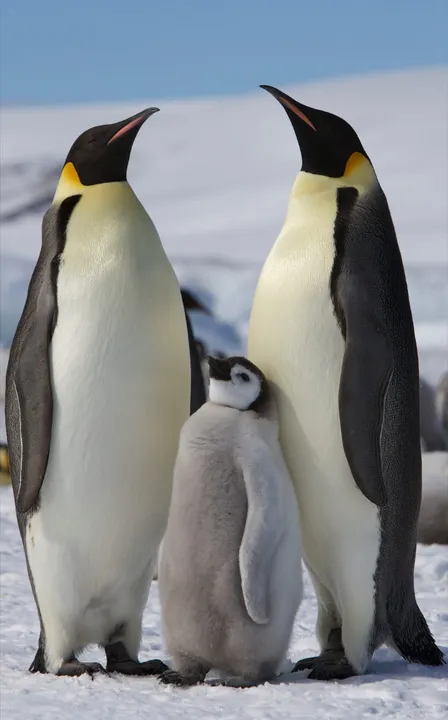
Nest: Not all penguins build the same kind of nest. Some use stones, some use burrows or vegetation, and emperor penguins hold the egg on the feet beneath a brood pouch.
Brood pouch: A fold of skin used by emperor penguins and some other species to protect an egg or chick. It is not a kangaroo-style pouch; it is a warming and sheltering fold.
Crèche: A group of chicks that gather after reaching a certain age while waiting for adults to return with food. It can reduce some risks, but it does not make chicks safe from everything.
Fledging: The stage when a chick has enough feathers and ability to leave the breeding site and enter the sea. For sea-ice breeders such as emperor penguins, early ice breakup can make this stage dangerous.
Moult: The period when penguins replace feathers. Because feathers control waterproofing and insulation, moult is survival work, not grooming. Catastrophic moult explains why many penguins cannot feed at sea while moulting.
Research and conservation
IUCN Red List: A global system for assessing extinction risk. Categories such as Vulnerable, Endangered, and Critically Endangered are standardized risk levels, not casual adjectives.
Breeding success: Often the proportion of eggs or chicks that survive to a defined stage. Weather, food, sea ice, predators, disease, and human disturbance can all affect it.
Satellite colony detection: Researchers can use satellite imagery to find traces of penguin colonies, especially in remote Antarctic sites. It makes large-scale monitoring more practical, but the images still need interpretation and verification.
Biosecurity: Rules that reduce the chance of carrying pathogens, seeds, soil, or non-native organisms into fragile places. Cleaning boots and gear, avoiding contact with animals, and following landing rules are all part of it.
Setback distance: The distance observers should keep from penguins. Rules differ by site, so one universal number is not enough. Before travel, follow the local manager and guide instructions.
References
FAQ
Who is this glossary for?
It is for readers who are new to penguin research, conservation news, or the ecology articles on this site.
Why do penguin articles talk so much about sea ice and krill?
Sea ice affects breeding platforms and food webs, while krill is a major energy source for many Antarctic penguins, seals, and whales.
Do these terms change over time?
Basic ecology terms are stable, but conservation status, population estimates, and disease risk can change. Always check dates and sources in news stories.