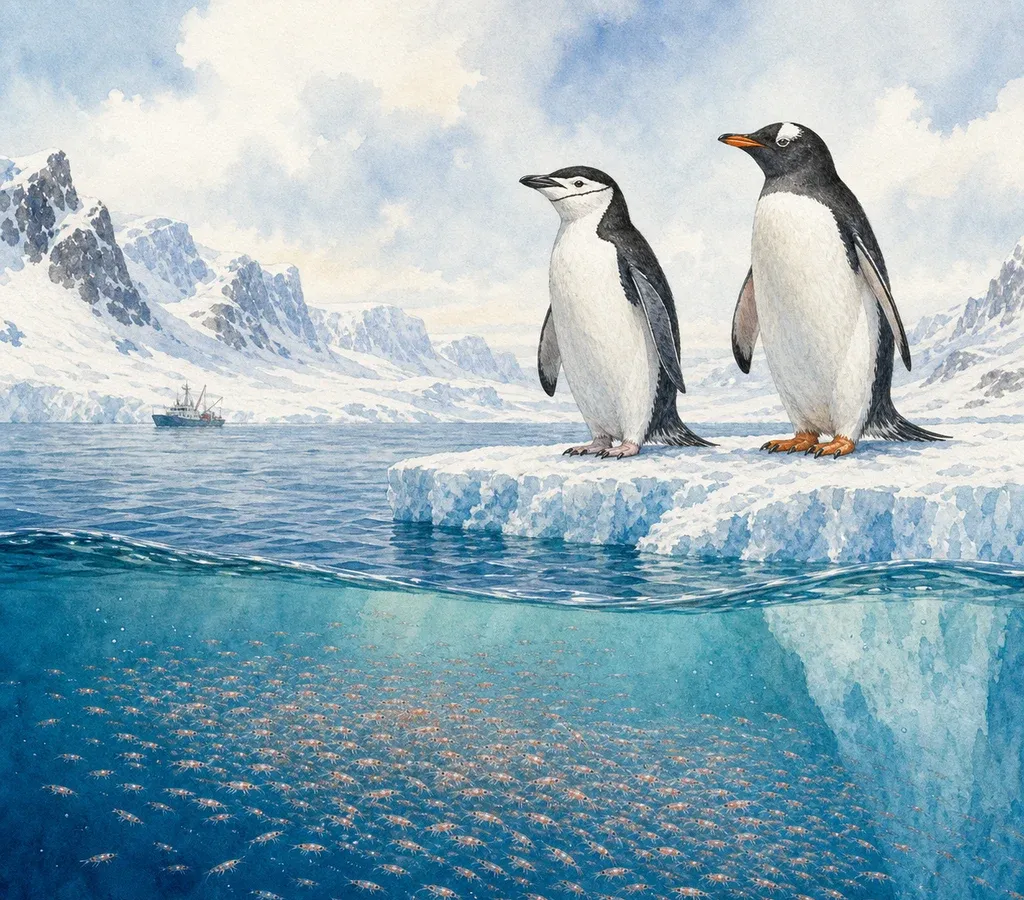
Antarctic krill are only a few centimeters long, but they make the discussion much larger.
The Antarctic food chain article follows krill through penguins, seals, and whales. This page looks in another direction: humans also fish in the same ocean.
The site layers are separate: the Antarctic food chain covers ecological basics, krill oil and penguins covers consumer products and certification, and Southern Ocean MPA politics covers governance. This page focuses only on how Area 48 krill fishing can locally overlap with penguin chick-rearing foraging areas.
The easiest way to flatten this subject is to turn it into simple good and bad. Vessels bad, penguins good. Quota small, therefore safe. Fishing exists, therefore dangerous. All of that is too simple.
The useful question is how total catch, place, season, and chick-rearing foraging range overlap.
CCAMLR is not managing one borderless bucket of krill
Antarctic krill fisheries are managed by CCAMLR. Its role is not to treat the Southern Ocean as an infinite warehouse, but to set limits around fisheries, predators, and the wider ecosystem.
CCAMLR material places Antarctic krill biomass in the hundreds of millions of tonnes, and the southwest Atlantic trigger level at 620,000 tonnes. That number looks conservative, especially beside total estimated biomass.
But total quantity is not the only issue.
CCAMLR also treats krill as a key species because whales, seals, penguins, squid, and fish all eat it. Natural predators consume very large amounts each year. The management problem is not a cartoon question about humans emptying the Southern Ocean. It is whether fishing in some areas and months overlaps with the exact supply predators need then.
Chick-rearing penguins have short radii
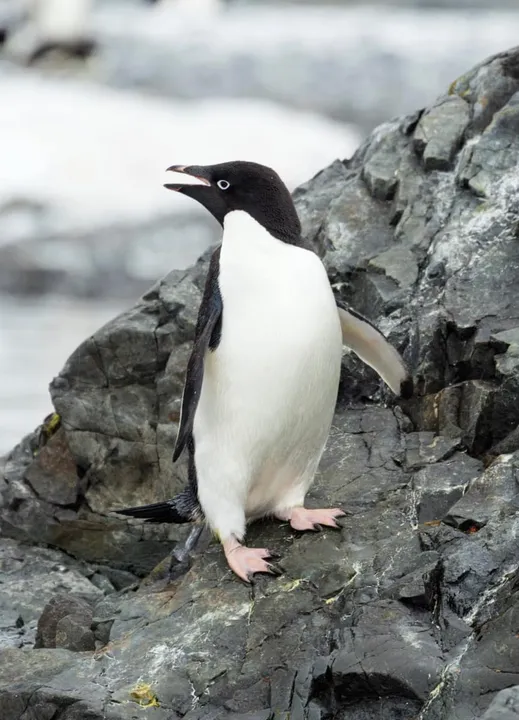
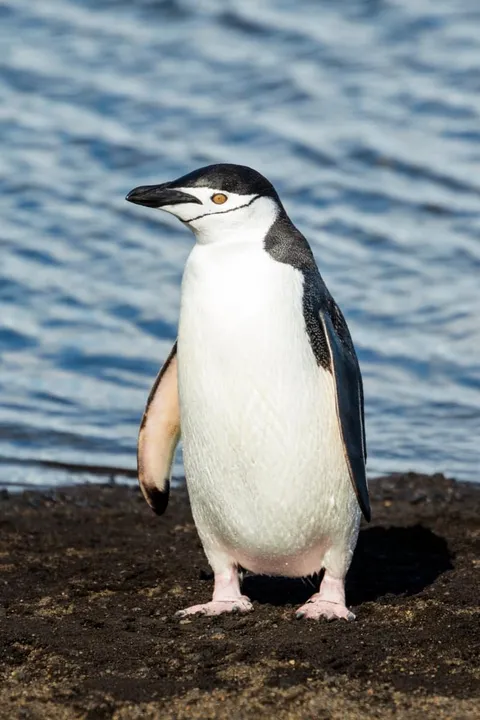
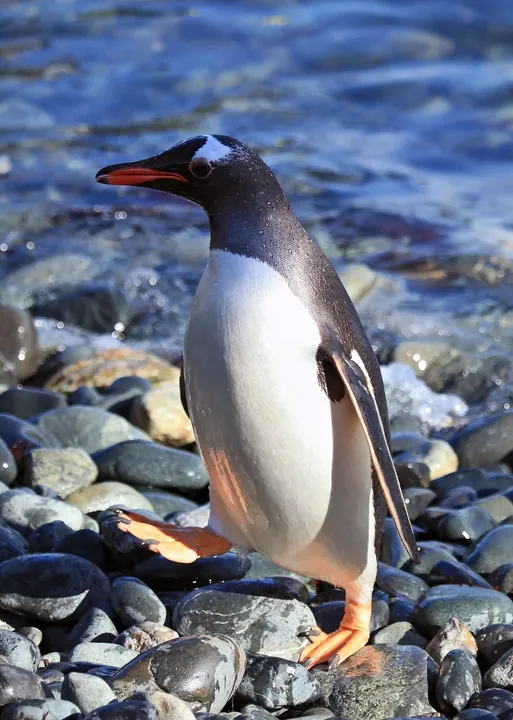
Chinstrap, gentoo, and Adelie penguins around the Antarctic Peninsula feed chicks by moving again and again between the sea and the nest.
They cannot extend that route without cost. Chicks are waiting at the nest. Parents must return to brood, defend against skuas, and keep the colony rhythm working. A longer trip means longer waiting time, higher adult energy use, and less margin.
That is why local overlap matters.
If vessels are spread widely, at low density, and outside sensitive seasons, the pressure looks one way. If fishing concentrates in a chick-rearing feeding area at the same time penguins need krill, the pressure looks different.
Looking only at “catch as a percentage of estimated biomass” misses that layer. The percentage can be low while local overlap remains real.
What Area 48.1 and 48.2 mean
CCAMLR divides the Southern Ocean into management areas. Krill fishing is currently concentrated mainly in Area 48 subareas around the Antarctic Peninsula and Scotia Sea.
You do not need to memorize the codes. The important point is that these areas also contain major feeding grounds for chinstrap, gentoo, and Adelie penguins.
CCAMLR’s public page lists Area 48 krill catch in 2024 at close to half a million tonnes. That remains within the management framework, but it shows that krill fishing is not just a small line on paper. It operates in real waters, in real seasons, near real breeding colonies.
The Southern Ocean marine protected area article covers governance. This page keeps one core point in view: spatial overlap.
Management is changing, while data lags
CCAMLR is not unmanaged. It has ecosystem monitoring and is developing a revised krill fishery management approach, including feedback-management ideas, so catch distribution can respond better to predator data, sea ice, population changes, and vessel location.
The hard part is that Antarctic data are slow.
Penguin colonies are not monitored every year at every site. Krill swarms move with ocean conditions. Sea ice varies sharply by year. Vessel data, penguin GPS tracks, acoustic krill surveys, and breeding-success records work on different timelines.
Managers make decisions before the data are complete. Conservation groups worry that buffers are too thin. Industry points to total catch remaining below limits. The scientific issue sits between them: total limits and local-overlap limits both matter.
How this connects to krill oil
If you arrived from the krill oil and penguins article, it helps to separate the layers.
The krill oil article covers consumer products, certification, and personal choice. This page covers ecology and fishery management. They overlap, but they are not the same question.
A penguin does not instantly lose one meal because of one capsule. The real scale is fleets, areas, seasons, quota, and monitoring. The question is not only whether a fishery exists. It is how catch is distributed, when sensitive areas are avoided, and how much buffer remains when data are incomplete.
Antarctic krill are tiny. The debate is large because they stand at the base of the food web and in the path of a visible human fishery.
References
FAQ
Who manages Antarctic krill fisheries?
The main body is CCAMLR, the Commission for the Conservation of Antarctic Marine Living Resources, supported by scientific review and ecosystem monitoring.
Why can a low total catch still matter to penguins?
During chick rearing, penguins cannot simply forage anywhere. If fishing concentrates in the same local feeding area and season, local competition risk can rise.
Is this article advice about whether to buy krill oil?
No. This page covers ecology, fishery management, and penguin-foraging overlap. Consumer choices are covered in the separate krill oil article.